interior
architecture &
design

For some people, an Interior Designer is someone who chooses cushions, colours and beautiful furniture. For others, Interior Design is something you can simply do yourself after watching enough renovation shows.
And, of course, there is always the friend who is a graphic designer who "has a great eye" and can probably help.
The reality is that Interior Design is a professional discipline that sits somewhere between creativity, problem-solving, technical knowledge and project planning.
1 Interior Design is a Luxury.
This is probably one of the biggest misconceptions.
Of course, you can watch renovation shows, browse Pinterest and Instagram, visit showrooms and make your own selections. There is an enormous amount of Interior Design inspiration available to everyone. And there is absolutely nothing wrong with doing that.
The difference is that inspiration isn't a design.
A renovation involves an enormous number of decisions. What goes where? What will fit? How will everything work together? What materials are suitable? What needs to be specified? What does the builder need to know? Have you considered lighting, storage, plumbing, electrical requirements, clearances and the way the space will actually be used?
An Interior Designer brings all of those decisions together into one cohesive solution.
Good Interior Design can also save money. Making the wrong selection, ordering the wrong quantity, discovering that something doesn't fit or changing your mind halfway through a renovation can be considerably more expensive than getting the design right at the beginning.
Interior Design isn't necessarily about spending more. It's about making better-informed decisions about where and how to spend your money.
2 Interior Design isn't hard. Anyone can do it.
But putting all of those decisions together into a space that is functional, cohesive and appropriate for the people using it is a very different proposition.
Interior Design involves understanding proportion, scale, colour, materials, spatial planning, lighting, ergonomics and how people move through and use a space.
It also involves problem solving.
Often, the most important Interior Design decisions aren't the things you notice immediately. They're the decisions that make a room work better - where the storage is located, how doors open, where the lighting is positioned, how much clearance there is around a vanity or whether the furniture arrangement actually works for the way a family lives.
A good Interior Designer is not simply choosing things. They're solving problems.
3 Interior Designers choose cushions and homewares.
Cushions and homewares can certainly be part of an Interior Designer's work, but they are a very small piece of the puzzle.
Interior Design can begin long before a cushion is ever considered.
It might involve reviewing the existing space, developing a concept, planning the layout, selecting finishes, specifying fixtures and fittings, considering lighting and storage, coordinating materials and colours, preparing documentation and communicating the design to the people who will actually build it.
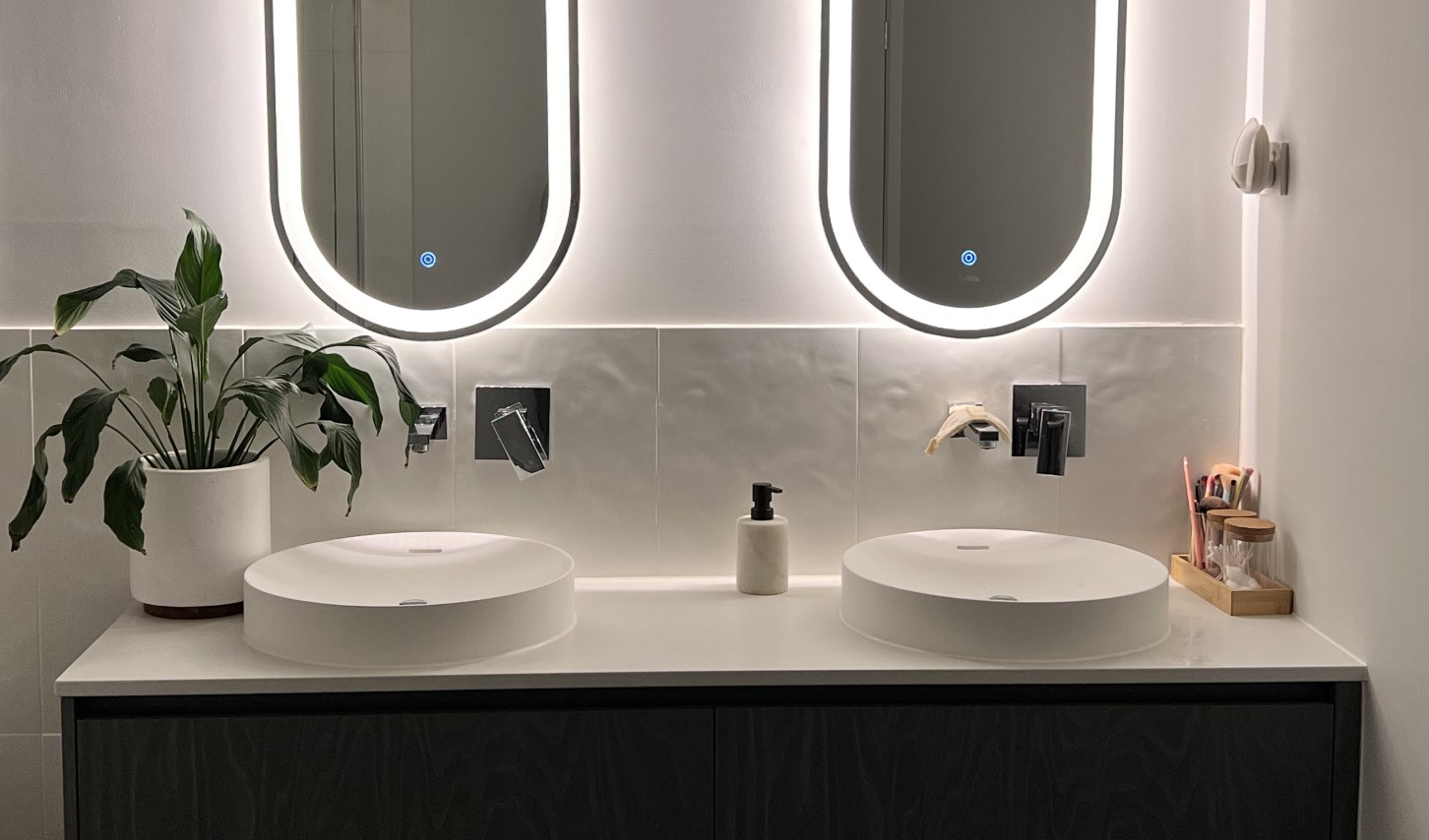
Take a bathroom renovation.
You might think the important decisions are the tiles, tapware and vanity. But before those choices can be made, there are questions about the layout, plumbing, lighting, electrical requirements, storage, clearances, materials, finishes and how all of the individual elements work together.
4 I don't really know what an Interior Designer does.
This is actually understandable. Unlike some professions, the work of an Interior Designer isn't always visible.
When you walk into a beautifully finished room, you see the result. You don't necessarily see all the decisions and problem-solving that happened before it was built.
An Interior Designer can help develop the overall design direction and then translate that concept into practical decisions.
That can include:
The exact scope varies from project to project.
Some clients might need help developing an entire renovation. Others may simply need assistance selecting finishes and fixtures or resolving a particular design problem.
The important thing is that an Interior Designer doesn't simply make a room look good. They help make the space work.
5 My friend is a graphic designer. Isn't that basically the same thing?
No - although there are some similarities.
Both graphic designers and Interior Designers work creatively. Both understand colour, composition, balance, proportion and visual communication.
But the environments they're designing for are very different.
A graphic designer primarily works in two dimensions - creating visual communication through things such as branding, typography, publications, packaging and digital design.
An Interior Designer works in three-dimensional environments.
That means considering physical space, dimensions, materials, construction, lighting, furniture, circulation, ergonomics and how people interact with the environment.
Your graphic designer friend may have an excellent eye for colour and design - and they may even be able to give you some great ideas.
But that doesn't necessarily mean they know whether your vanity will fit, how much clearance you need around your toilet, which flooring is appropriate for a particular area, how a joinery detail needs to be documented or how all the selections need to be communicated to a builder.
Different professions have different areas of expertise.
So, what are you actually paying for?
Ultimately, engaging an Interior Designer isn't simply about having someone choose beautiful things for you.
You're paying for experience, knowledge, problem-solving and the ability to bring hundreds of individual decisions together into one considered design.
You can absolutely renovate your home yourself. But that doesn't mean you have to do everything yourself.
Sometimes the most valuable part of engaging an Interior Designer is having someone who can step back from the individual decisions and look at the project as a whole.
Because good Interior Design isn't about buying more. It's about making the right decisions, in the right order, for the right reasons.
And when those decisions are made before the renovation begins, the finished space has a much better chance of being beautiful, functional and uniquely suited to the people who live there.